

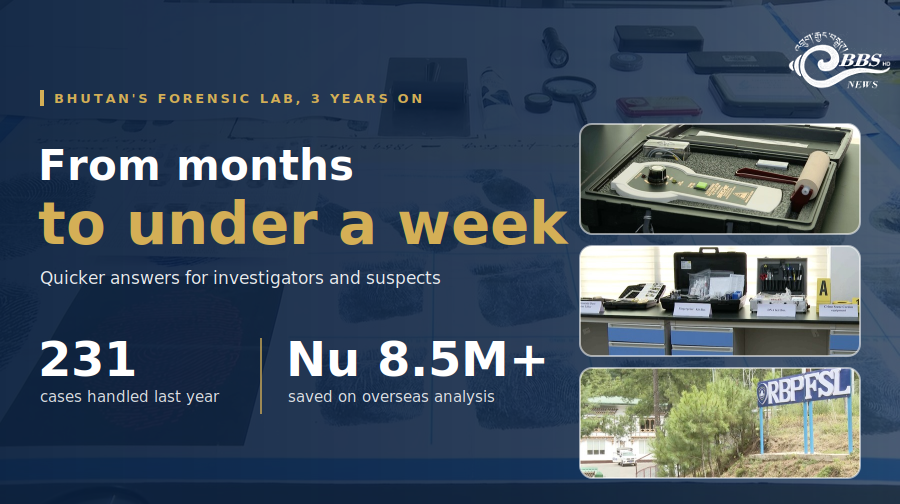
What once took months can now be completed in less than a week, as Bhutan’s first forensic science laboratory continues to transform the way police investigate crimes.
Located at Serbithang in Thimphu, the forensic laboratory has been operational since November 2023, bringing DNA, fingerprint and digital forensic services under one roof. The facility has significantly reduced the time police spend waiting for forensic results, while also cutting the cost of sending evidence abroad for analysis.
Before the laboratory was established, Bhutan had to rely on forensic facilities outside the country. Evidence collected during investigations was sent mainly to India and other countries, with results sometimes taking around a year to arrive.
Police records from 2021 show that 137 forensic cases, involving more than 1,000 samples, were sent overseas for analysis.
The situation has changed considerably with the establishment of the domestic laboratory. According to police, the entire process—from analysing evidence to preparing forensic reports—can now be completed in less than a week in many cases. This has provided investigators with quicker access to evidence and helped speed up criminal investigations.
The laboratory handled 231 cases last year. Of these, 102 were DNA-related cases, 92 involved digital forensics and 29 were fingerprint cases.
Between January and August this year, the laboratory handled another 90 cases. DNA analysis accounted for the largest share, with 52 cases, followed by 25 digital forensic cases and 13 fingerprint cases.
The availability of forensic services within the country has also brought significant financial savings. Police said the laboratory has saved more than Nu 8.5 million in overseas courier and analysis costs during its first 20 months of operation.
The savings are not limited to financial resources. Keeping forensic analysis within Bhutan also reduces the logistical challenges associated with transporting sensitive evidence abroad and waiting for results.
For investigators, faster forensic reports can help establish links between suspects, victims, objects and crime scenes at an earlier stage of an investigation. At the same time, forensic evidence can also protect people who may have been wrongly suspected of committing an offence.
DNA analysis, for instance, can help identify a person or exclude an individual from an investigation. Fingerprint examination can establish links between individuals and objects or locations, while digital forensics allows investigators to recover and analyse information stored on phones, computers and other electronic devices.
Police say these forms of evidence have become increasingly important as criminal investigations grow more complex and technology plays a larger role in everyday life.
A phone, a fingerprint or even a small biological sample can provide critical information about what happened at a crime scene. Having the capacity to examine such evidence domestically means investigators no longer have to depend entirely on foreign laboratories.
The forensic laboratory therefore represents more than a new facility for Bhutan’s law enforcement agencies. It marks a shift towards faster, more efficient and more self-reliant criminal investigations, while reducing the financial burden of sending evidence overseas.






















Leave a Reply